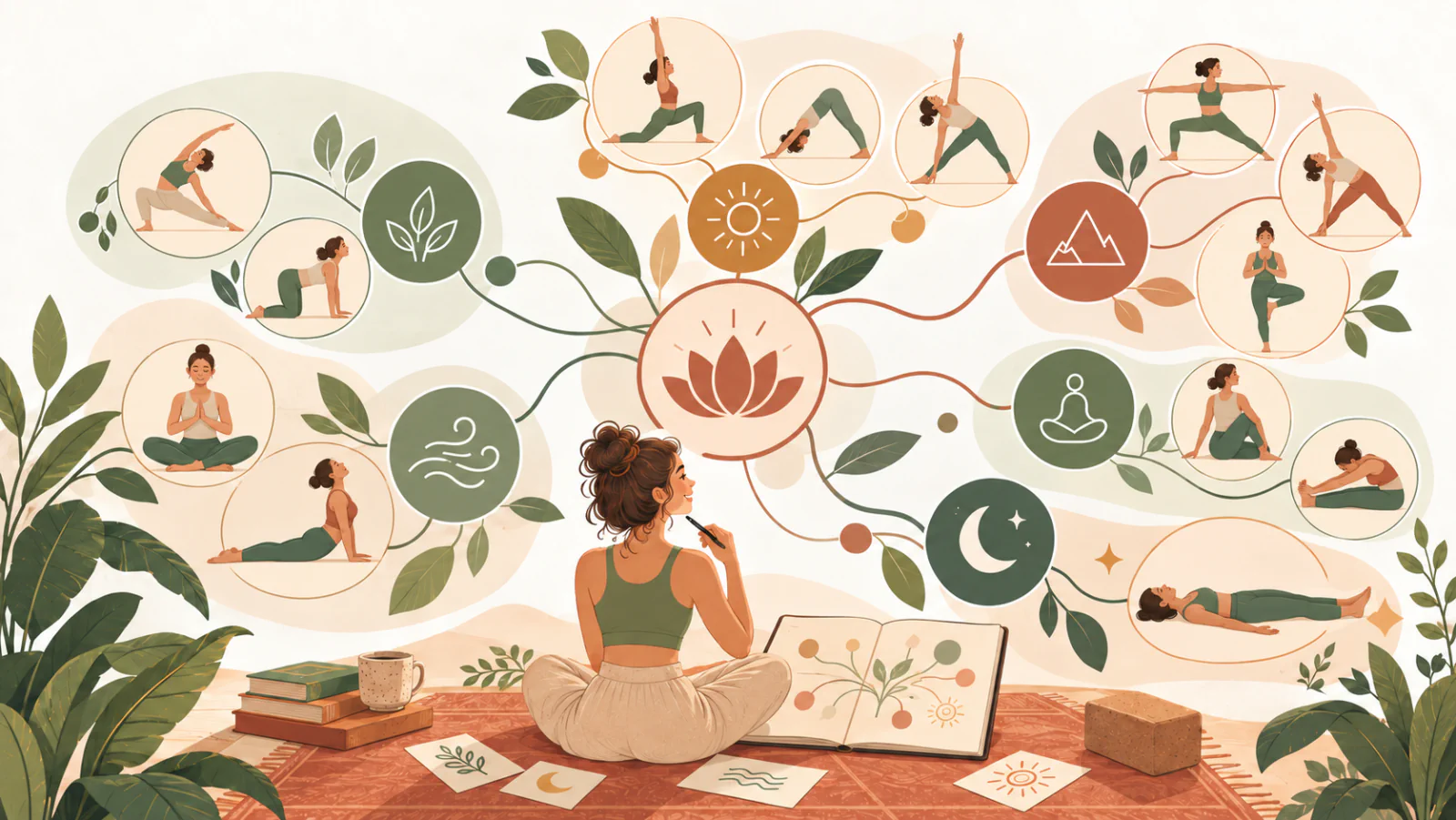
A mind map opens up possibilities before you lock yourself into writing a rigid timeline. It can be helpful when you have a broad theme or a spark of inspiration, but have not yet made concrete decisions about how to explore it physically.
Use Different Kinds of Branches
Put your theme in the center of the page and add four main branches: movement, questions, pacing, and environment. For a theme like “space,” you might note foot spacing on the mat (movement), a deliberate pause between cues (pacing), a question about the distance between the shoulders and ears (questions), and a different mat arrangement (environment).
Separate Association from Justification
Just because a word is associated with your theme does not prove the idea is suitable for a physical practice. Ask yourself how each suggestion will be experienced in the body. A branch on your map can remain empty; there is no need to fill it with an invented symbolic or physiological explanation just to make the theme fit.
Draw One Route
You can then arrange those ideas into a sequence in Creasana.
Creasana · Workshop
Try it in your planning
- Draw four distinct branches around a central theme.
- Add two concrete, physical ideas to each branch.
- Connect three ideas into a clear, logical route.
- Explain that route in two sentences before choosing your poses.
References for further exploration
These planning examples should be adapted to your group and training. References provide context for the topics discussed; they do not validate every example sequence.