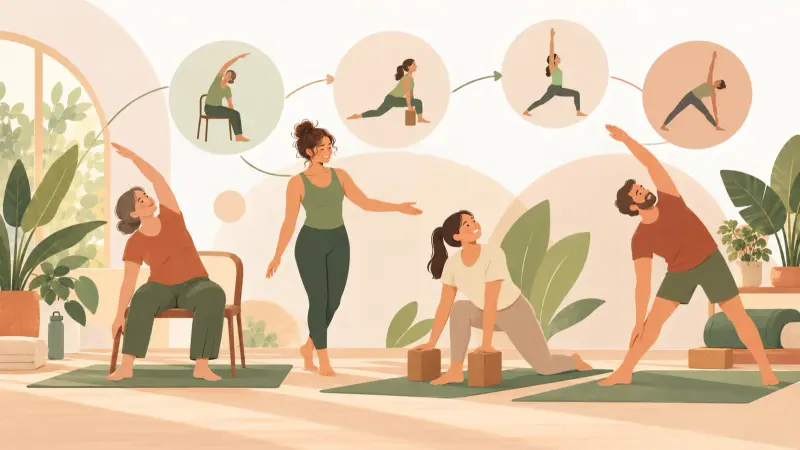
An option is only available when students know they can choose it without judgment. How you introduce a variation matters just as much as the modification itself. Presenting multiple ways to participate without labeling one as “easy” and another as the “better” destination helps make teaching accessible.
Name the Change, Not the Difficulty
Describe the support or the action taking place. Use phrases like “with one hand at the wall,” “with knees down,” or “remaining seated.” Labels such as “easy,” “beginner,” or “advanced” can shift a student’s attention toward social comparison. A concrete description helps students adjust their practice without ranking the options.
Offer Choices Early
If a modification is introduced only after several difficult attempts at a pose, it can feel like a fallback or a failure. Instead, present two routes from the outset and explain each fully. Both need an understandable entry and exit, and neither should be framed as the default.
Observe Without Deciding for Someone
Creasana · Workshop
Try it in your planning
- Find three places in your recent class notes where you say “easier” or “advanced.”
- Replace those labels with a concrete description of the physical shape or prop used.
- Prepare both practice routes at the very beginning of the sequence block.
- Check that each option has a clear, safe exit.
Prepare your class and its variations in Creasana.
References for further exploration
These planning examples should be adapted to your group and training. References provide context for the topics discussed; they do not validate every example sequence.