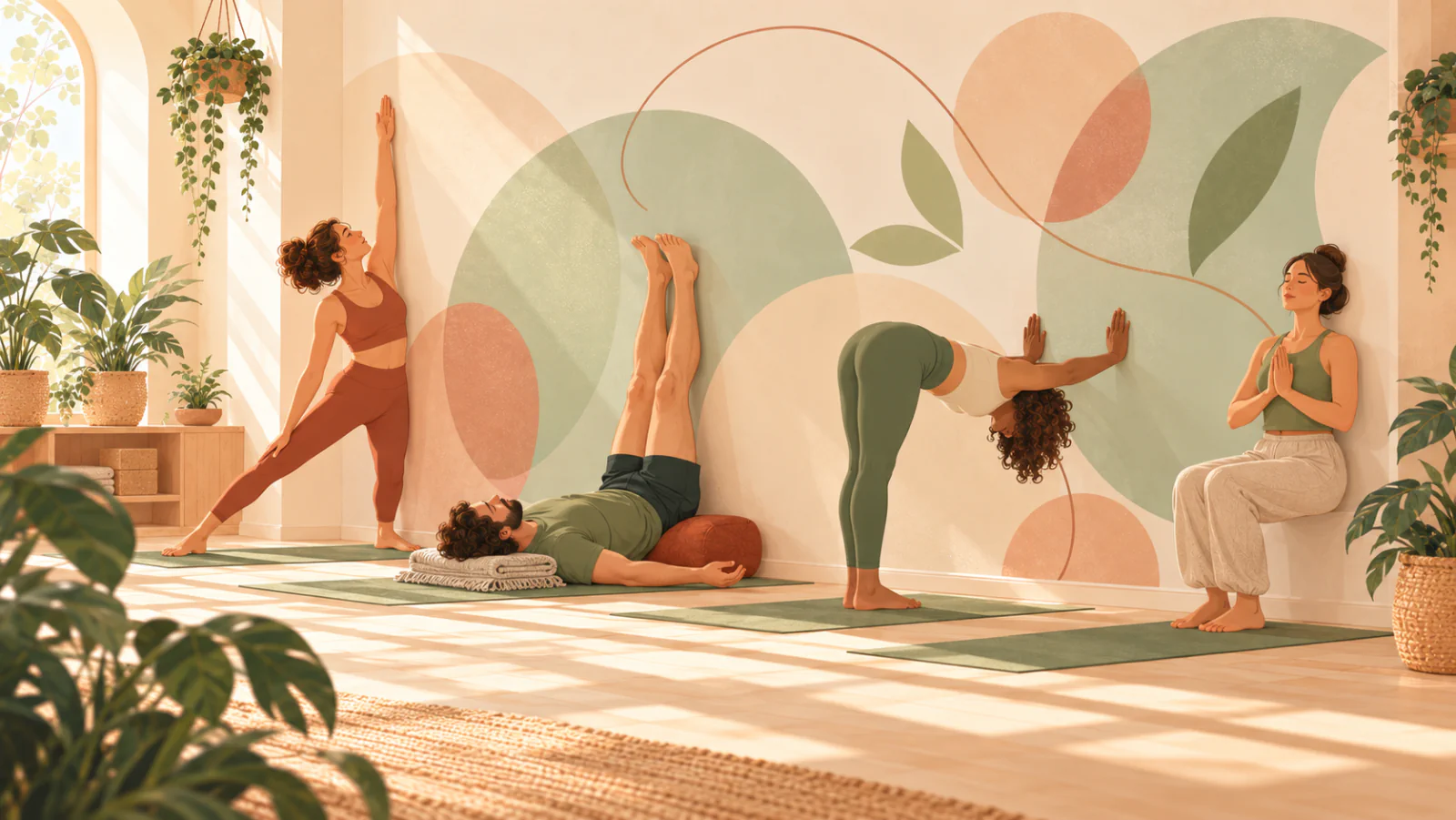
A wall can serve more than inversions. It offers a contact reference and changes some balance tasks. It does not remove fall risks or a pose’s demands: its usefulness depends on the setup and your purpose.
Explain the Purpose of Contact
A hand on the wall may help students explore a weight shift. Explain what they might notice: distance, light pressure or a steady support. Touching the wall alone does not guarantee better alignment or a feeling of safety.
Change Orientation Thoughtfully
Some standing actions can be explored seated or lying near the wall. This also changes effort and transitions; it does not remove gravity altogether. Test the arrangement and offer an uncomplicated exit.
Check Space Before Class
Count usable places, remove obstacles and avoid fragile surfaces. Do not treat the wall as sufficient protection for teaching an inversion outside your competence. Finishing with legs up the wall remains an option, rather than a universal resting position.
Creasana · Workshop
Try it in your planning
- Check how many wall spaces are available.
- Define each contact’s purpose.
- Test entries and exits.
- Prepare an option away from the wall.
Continue reading: Exploring Hip Mobility Without Chasing Extreme Range.
References for further exploration
These planning examples should be adapted to your group and training. References provide context for the topics discussed; they do not validate every example sequence.