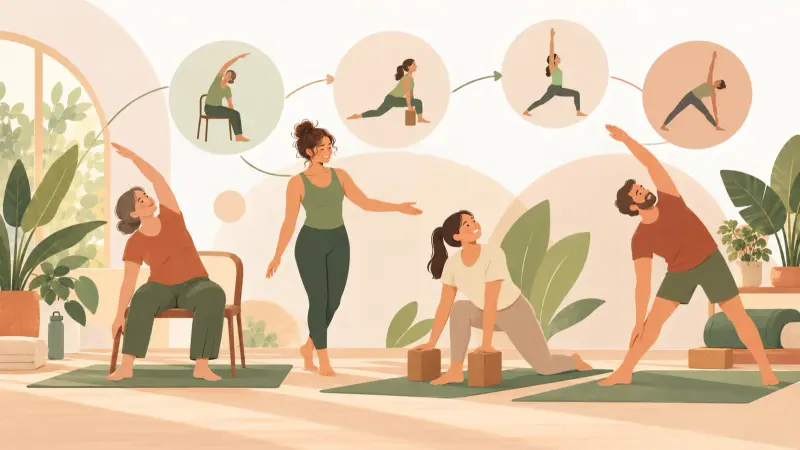
Demonstrating every pose can make it harder to see what students understand. You do not have to leave your mat for the whole class. Alternate between showing a useful movement and watching the group try it. Clear words and time to experiment are part of teaching too.
Make Your Words Specific
Choose a familiar passage and describe the supports, direction of movement and way to stop. Replace “do what I do” with an observable action. If the group hesitates, a brief demonstration may help. Teaching without moving is not a test you must pass at all costs.
Observe Without Intruding
Stand where you can see the group without surprising someone from behind. Watch changes of position and requests for help. Hesitation does not necessarily indicate a physical problem: first check whether your cue was clear. Do not infer someone’s needs from their appearance alone.
Keep Your Plan Within Reach
Check your plan before the next passage, then return your attention to the group. Printed notes or a discreet screen can help without taking over. Stay within your training and do not treat observation as a medical assessment.
Creasana · Workshop
Try it in your planning
- Choose a familiar warm-up.
- Describe the supports without demonstrating.
- Keep your notes accessible.
- Record one cue to clarify after class.
Continue reading: Beyond “Did You Like It?”: Improving Yoga Classes With Useful Feedback.
References for further exploration
These planning examples should be adapted to your group and training. References provide context for the topics discussed; they do not validate every example sequence.